June 6th, 2012 at 1:08 am 
Mention the words “hidden camera” or “spy cameras” to ten different people and you'll likely receive ten different thoughts and opinions. For many, it might mean a nanny cam for home to keep an eye on their kids while at work as well as to observe the behavior of a babysitter or nanny. For others, it can mean collecting proof of a family member pilfering money out of a wallet or desk drawer. A wife or husband may utilize a concealed camera to help confirm a suspicion their spouse could be fooling around on them. Employers often utilize covert monitoring in order to watch over their employees, while a number of employees will place a spy camera on their desktop or work space to safe guard possessions against theft by the nightly cleaning crew. There are as many good reasons why people use a hidden camera as there are in the variety of cleverly disguised spy cameras to choose from.
The usage of video is everywhere these days. What was once associated only with spies and covert operatives employed by the government, now can easily be found in several digital camera stores and bought by everyday consumers. Today, hidden video cameras can be found in stores and retail shops, commercial offices, factories, airports, train stations, and on almost every street corner in the city. In fact, it is virtually impossible not to be recorded somewhere in the course of a normal day, especially if you live in or near a metropolitan area.
Here are a few other popular or unusual purposes for covert spy cameras.
We've practically all seen law enforcement shows on television where a meeting room is bugged with hidden audio and video surveillance equipment to gather evidence for a sting operation, or where an officer is wired when going undercover. Likewise, investigative journalists may use a spy camera to be able to document proof regarding a scam artist, or in health violations taking place in the kitchen of a restaurant or food packing plant, or perhaps in a article relating to animal cruelty. Many companies may use video recording as an effective training tool for their workers, especially with regard to their sales staff when practicing their presentations to clients. Other companies utilize hidden cameras when launching new products and services to the market and want to obtain a sampling of consumer response. This could be a taste test between Pepsi and Coke, or the release of a new and improved corn chip by Frito Lay.
An increasing number of employees today are resorting to spy camera recorders in the work place to document proof of verbal and physical discrimination. Sadly, sexual harassment towards women in the workplace continues to rise, while the laws protecting us from all forms of discrimination and harassment continues to be watered down by the courts. HR departments are usually caught in the middle of these claims, and without documented proof to support assertions of age, race, or sexual harassment, HR will always side with the company to avoid getting into legal entanglements. This is where a hidden camera can supply the evidence you need. With the occurrence recorded on video and audio, your proof now becomes irrefutable.
Last, but certainly not least, is the need to document eldercare abuse. The abuse of our elderly is significantly more prevalent today than a generation ago. A newly released government investigation showed that 60% of all nursing homes in this country experience some kind of elder abuse. Often these victims are immobile, may suffer from dementia or Alzheimer's, and have a difficult time in verbalizing their abuse. If you're a family member caring for an elderly parent or grandparent in a nursing facility, a hidden camera might be the only way to document that your loved one is being properly cared for and attended to.
The thing that makes these cameras so effective is that they can be hidden in everyday products found in your home or place of work. In fact, they're so common most people don't glance twice at them, or would ever suppose there's a video camera found inside. Hidden spy cameras may be found in wall clocks, AM/FM digital clock radios, picture frames, room deodorizers, tissue containers, coat hooks, table lamps, desktop calculators, flower pots, smoke alarms, fountain pens, and stuffed teddy bears. There is virtually no object that can't be transformed to a hidden spy camera for home or work.
There is also a big selection of body worn covert cameras, such as spy watches, Bluetooth cameras, spy pen camera, and camera glasses. These, and hundreds of other widely used hidden cameras have become more simpler to use than ever due to the fact the DVR is built in. In discarding the necessity for wires and wireless receivers, these basic cameras can record the video and sound onto themselves using a normal SD card. With up to 32GB of memory, they will furnish you with several hours of recording time. Another aspect that's generally found is a motion detection setting, thus extending the recording time even further by only activating the camera to come on when movement is detected. When you're ready to see the video, you can just simply connect the camera to your pc with the supplied USB cable, or remove the SD card and place it straight into the computer or SD card reader.
|
December 9th, 2011 at 6:31 pm
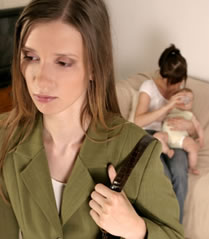 |
As a parent, our primary role is to protect our children, but for many of us it's not possible to keep a watch on them 24 hours a day. When leaving for work in the morning it's natural to experience some anxiety when leaving our children with another person. This may be the nanny, a babysitter, or even a family friend. To help ease that anxiety of leaving children under the care of someone else, many parents are choosing to install a "Nanny Cam" to keep an eye on how the caregiver is behaving with their children.
Unless you're intimately familiar with the person who will be caring for your children while you're at work, finding someone you can entrust your children to and feel good about is your first concern. Remember, people have a tendency to present themselves one way in your presence, and then act differently when you're gone. Ask yourself these questions:
|
1. Is the babysitter or nanny the only one around your child when you leave? Do their friends or boyfriends enter your home after you've gone?
2. Have any of your personal items gone missing without explanation? Jewelry and cash are the usual targets.
3. Is your nanny or caregiver watching TV and talking on the phone all day? Is your child being neglected?
4. Does your nanny or babysitter have a drug or alcohol abuse problem?
5. Worse of all, are they abusing your child? Verbal and physical abuse of children happens every day in this country.
Why a Nanny Cam?
Recently, there have been a lot of cases of abuse from caregivers that have gained media attention. While it's not advised to believe that all nannies have the potential to mistreat children, it is still a problem that should cause some concern. While many potentially abusive nannies can be screened out during the proper interview process, it can still be difficult to know when you're choosing a nanny that is truly dedicated to keeping your children safe.
For a concerned parent, a Nanny Cam can help you gain insight in how your nanny is interacting with your children while you're away. It can either provide you with peace of mind, or allow you to identify a potentially dangerous situation for your children.
What kind of Nanny Camera should I get?
Basically, a “Nanny Cam” is a hidden camera that you install in a non-visible location inside your home. This camera may be hidden in a potted plant, a stuffed animal, a desk lamp, or other household object. The primary purpose of the camera is to allow you to see how a caregiver interacts with your children when you're not around. The two main types of cameras are wired and wireless. As the name implies, wired cameras are direct connected to a PC or some other kind of recording device, like a VCR. This is the most economical option, but concealing the cable can sometimes be a bit of a problem, especially if you're running it for several feet. A wireless camera solves that problem by eliminating the cable, and all come with a 2.4 GHz receiver which connects to the PC or recorder. Signal strength is around 300 feet. With either camera you would press “record” before leaving in the morning and “stop” when you return. You then open the video file you've created and fast forward until something catches your attention. Depending on how many hours you've recorded, this can be very time consuming.
Motion Activated Nanny Cam
Using a motion activated nanny cam is a bit better option. Whenever motion is detected within its sensing range, the camera comes on to trigger the recording device (PC, VCR, DVD) to start recording. When motion stops, it automatically resets itself to standby again to await the next movement. This makes the viewing of the captured video much easier.
The StealthCam Option
The StealthCam systems are the next step up in hidden cameras. They feature the camera and the digital video recorder in one self-contained unit. They also have an “adjustable” motion activated recording system built in, so basically all you need to do is plug it in, turn it on with the included IR remote control, and you're good to go.
The StealthCam system records onto an SD memory card, which can be found everywhere. All of today's digital cameras use SD cards. The StealthCam systems can support up to 32GB, which is inserted into a hidden slot somewhere on the camera.
The StealthCam systems can either record full motion video (30fps) or take snapshot pictures every 3 seconds while motion is detected. Video is best, although it consumes roughly 1GB for every 2.5 hours of video. StealthCam nanny cams can be found in everything, from clocks and radios to stuff bears and picture frames. To see what the camera has captured, either remove the SD card and pop into your PC or card reader, or connect the included USB cable right from the camera to your computer.
A StealthCam system with built-in DVR (SD card) is the most popular nanny cam on the market. Although they have typically cost more than wired or wireless cameras, the prices continue to fall. The technology has also improved, to where now you can get a simple working pen or wristwatch with the same built-in recording ability for just over $100. In fact, with a StealthCam system being disguised into so many common everyday household products, you could afford to place a motion activated nanny cam into two or three rooms of your house.
|
October 2nd, 2011 at 10:50 pm
There is so much information available on the Internet, it can sometimes be overwhelming. When it comes to self-defense this is no exception. A large amount of information is available about various self-defense products, techniques and tips from experts. With all this online self-defense information, there is just no excuse for people not to invest in the product or experience necessary to guard themselves against an assailant.
National law enforcement statistics tell us that more than 1.3 million crimes are committed every year. Don't be a victim to a carjacking, forcible rape, aggravated assault or robbery, and don't become another statistic. If you have knowledge of self-defense or carry a self-defense device, you have the additional tools to prevent an attack or free yourself, should it happen.
At The Covert Eye, your safety and security is our main concern, and that is why we offer such a large selection of home and personal protection products for you to choose from. Feeling secure should be the right of everyone. Along with our personal alarms and diy home security systems, a big part of our business is in our selection of non-lethal self defense items, such as Tasers, stun guns, MACE and pepper sprays. These products offer not only some peace of mind in knowing you're not completely vulnerable, but their effectiveness can be attested to in police reports every day.
Sadly, every month we will get a handful of orders from individuals who happen to live in selected states or cities where the purchase or possession of such a device is made illegal. Such states include Connecticut, Illinois, Hawaii, Massachusetts, Michigan, New Jersey, New York, Rhode Island and Wisconsin. Restricted cities include Annapolis, Baltimore, Chicago, Washington D.C., and Philadelphia.
|
My question has always been, why is that? We are not talking handguns or assault rifles, but simply a shot of oleoresin capsicum to the eyes, or electric shock to the body, both of which are only meant to temporarily disable a person, allowing the victim time to get to safety. If you were to ask law enforcement their thoughts, nearly all of them would like to see these non-lethal devices made legal in their states. It is far better to take a report of an attempted rape from a live victim rather than from one lying in a morgue. Unfortunately, old laws are hard to overturn, and the number of reported muggings, rapes, and personal assaults continue to climb.
Not long ago I spoke with a mother, whose daughter was attending college in Massachusetts and who was concerned about her safety at night when she walked alone from the library back to her dorm room. Apparently the
|
 |
campus was beautifully landscaped, but at the same time the well manicured grounds also provided excellent concealment for any would-be attacker. She wanted to give her daughter a disguised cell phone stun gun to carry with her at night for personal protection, but stun guns are illegal in that state. She then thought about purchasing some pepper spray, which in Massachusetts can only be done from a licensed firearms dealer, but then she ran up against the college's policy that made it illegal for any student to carry in their possession pepper spray or Mace while on campus grounds. It was a dilemma she wrestled with. In the end, she bought the pepper spray and gave it to her daughter, anyway. A semester later the worry became a reality. While walking back to her dorm around 10:00 at night the daughter was suddenly attacked by a single male, who forcibly grabbed her and tried to drag her behind one of the hedges. Struggling to break free, she managed to get the pepper spray in her hand and began squeezing the spray in the direction of her attacker. One of the attempts found its mark, and the attacker suddenly let go, his hands going quickly to his face and eyes. The girl then ran back to her dorm, where she immediately called campus police.
The attacker was never found, but now her daughter was facing disciplinary action from the Board of Regents for violating policy about the possession of pepper spray on college property. The mother was worried that the board members could either suspend her, or even worse, take away her scholarship. I told her that in my opinion to even consider punishing a victim of attempted rape for fighting back, no matter what the policy, is to me totally unjust and unfair. I then added, “while I know you are concerned with the hearing your daughter will be having with the Board, and what decisions could come from it, at least you should be relieved and thankful that your daughter is alive and well to even attend the hearing.”
With that, she couldn't disagree.
Here, at The Covert Eye, we believe it is the right of every American to defend themselves and their families when confronted by intimate danger and physical harm. A non-lethal self defense weapon provides the perfect means of protecting you and your loved ones in such situations, without having to resort to deadly force. If you believe that Tasers, stun guns and pepper sprays should be legal and available to anyone, no matter the state or city, we would love to hear your thoughts and opinions. Even if you have a different view, we would like to hear your thoughts as well.
|
September 7th, 2011 at 9:10 pm 
As many as 50 Phoenix police officers may soon be wearing tiny convert video surveillance cameras as part of their uniform accouterment if a $500,000 grant is approved in early September through a joint partnership with Arizona State University and the U.S. Department of Justice. The grant is being called The Smart Policing Initiative.
Earlier this spring, a pilot program was tested with 18 officers wearing the small hidden spy cameras attached to their uniform in an effort to increase police transparency with the public. The three month trial, which concluded in June, resulted in 860 hours worth of video. From among the recordings, portions of the footage will be used as evidence in 62 cases going before the court.
The spy camera is worn like a Bluetooth device around the ear, and can be turned on and off from a remote control on the chest. A pocket recorder, or small video monitor, is attached to the belt. Once activated, video can't be edited or deleted.
Arizona law requires at least one person be aware they are being recorded, although the law is not well defined in how that is communicated or acknowledged, and can likely not even register depending on the situation or number of persons being confronted by officers. During the trial period some citizens did key in on the cameras being worn and asked if they were being recorded.
During the pilot program, Phoenix police tested Scottsdale-based TASER International's Axon cameras, which are more obvious in their appearance than traditional covert cameras of the same type, and come with a more heftier price tag. The cost of Axon cameras are about $1,700, plus an annual $1,200 each to archive the video footage. Likewise, a comparable wireless Bluetooth covert camera from any local security store runs about $200. The grant doesn't specify which brand of cameras are to be used, but does require the police agency to enlist a research partner. In the case of Phoenix it will be A.S.U., who will collect and analyze the data and calculate the effectiveness of their efforts.
The “Candid-Camera” officer video pilot program was one of 34 recommendations developed by a Phoenix task force last January to help improve relations between the police department and the community. The task force came into being in April, 2010, after several incidents involving the police angered citizens, including a March 2010 incident which saw City Councilman Michael Johnson, an Afro-American, wrestled to the ground and handcuffed by a White police officer.
With the eye of “Big Brother” becoming more prevalent in our daily lives now, and technology providing a video recorder to anyone with a cell phone, providing police officers with a wearable video recording device is the logical next step in the progression. How this plays out over time and the legal impact it could carry will be questions that will no doubt be discussed, but for now it may give us pause to be mindful of what we say and how we respond the next time we are confronted by an officer of the law.
|
September 7th, 2011 at 8:10 pm
Did you know that you're an easy target? We all are. That's what you'll hear from police, security experts, and especially people who have spent time on the other side of the law. As vacation season winds down, be aware that crime doesn't take a holiday. In keeping with last month's newsletter on how to help protect your home from burglary, here are six other ways you can stay safer.
1. Keep a financial inventory. Once a year take out all of the cards in your wallet, make a list of the account numbers and contact information you'll need to cancel cards if they become lost or stolen, and hide it in a safe place.
2. Watch out for imposters. The fastest-growing scam in the past year has been imposter fraud, according to the latest annual report on consumer complaints from the Federal Trade Commission. Thieves claiming to be someone they're not (such as a friend or relative stranded overseas in need of cash to get them home, a bill collector, or an employee of a government agency) use Facebook messages, email, phone calls, and text messages to persuade people to send money or divulge personal information such as Social Security or account numbers. Last year 60,000 people reported that they were affected by this form of fraud, up from just 5 cases reported in 2008.
3. Change your PIN. Make it a habit to routinely change the secret code for your debit card or ATM card. That gives you better protection against any thieves or skimming schemes.
4. Learn to parallel park. Car thieves are becoming more professional. They're stealing new cars by putting them on a flatbed tow truck. Parallel parking hinders access to the front and rear of your car, making it difficult to tow. Also, be careful about whom you bump into at the grocery store, especially if your car has keyless entry and a push-button ignition. A thief with an antenna and a small kit of electronics can transmit your key's code to another thief standing near your car, allowing him to open it, start it, and drive it away.
5. Change your Wi-Fi password. If you have a home wireless network, choose the highest security option. That way your web-browsing and financial transactions will be more protected. Go a step further and create your own administrative password rather than relying on a default password supplied by the router.
6. Hide the stuff in your car. Don't leave electronics and other valuables visible inside your car. GPS units are less of a magnet these days; cell phones and laptops more so. Holiday gifts are a big target, so don't stack them up in the backseat. Is there a worse move? Yes. Leaving your stuff in the back of a pickup truck.
|
August 11th, 2011 at 8:58 pm
American homes are victims of burglary about every 15 seconds, according to the U.S. Department of Justice. The typical homeowner suffers a loss of nearly $2,000 in stolen goods or property damage.
"With the national economy getting worse, burglary is again becoming a more common crime," said Charles Sczuroski, a former police officer and now senior trainer for the National Crime Prevention Council.
If you have a high deductible on your homeowners insurance policy, you'll likely have to pay out of pocket to replace your stuff. But for a small investment, you can make your home less appealing to burglars in the first place.
9 Ways To Protect Your Home From Burglary
1. Prune your shrubs. Bushes, shrubs and trees can offer an intruder places to hide and camouflage signs of a break-in. Trim back any overgrown vegetation so that your home's windows, porches and doors are visible to neighbors and passersby. This doesn't cost but a few hours of your time, yet it can make a difference in making your property much less attractive to a burglar.
2. Draw the blinds. Use shades, drapes and other window treatments to keep potentially tempting household items out of view. Burglary is sometimes a crime of opportunity and "window-shopping" is one way criminals choose potential targets.
3. Don't advertise new purchases. Be sure not to draw undue attention to your home by discarding empty boxes at the curb with your trash -- a big problem during the holidays. By putting out boxes from a new flat-screen television, video game system, a laptop computer or other expensive home electronics at the curb, you're showing a potential burglar exactly what new and valuable items are now available in your home.
4. Get motion sensors. Adequate nighttime illumination is critical, because a dark or poorly lit property makes it easier for a burglar to go about unseen. The best deterrent for crime and therefore safety for your home and family is to install motion-sensing security. Motion-sensing security lights are ... activated when motion is detected and the sudden change from darkness to the bright light will not only startle intruders, but also provide a visual alert to the homeowner and neighbors.
5. Set timers indoors. Many insurance companies recommend using timers that are hooked up to indoor lights, as well as radios or televisions. Setting a timer to switch on about 30 to 45 minutes before it gets dark makes it appear more like someone is really at home, and combined with a radio or TV activating during the day and evening, that impression can be even more convincing. Burglars generally don't want to be confronted by anyone in a home. They basically want to slip in and out unseen. If they hear sounds of activity, they'll generally move on.
Timers can run from about $5 to $40, depending on their sophistication. A basic plug-in unit can turn a light on and off once or twice a day, whereas a wired digital outlet switch can switch lights on at any number of set or random times.
6. Reinforce entry points. Sixty percent of all burglaries take place at ground floor doors and windows, so it makes sense to "harden" these entry points. All entry doors should be solid wood or steel-wrapped wood-core doors. Hollow-core doors or rickety old wood-panel doors can be kicked in easily and don't offer much of a deterrent. New solid (slab) doors cost around $100. Installation, of course, will cost extra. However, an experienced home handyman can tackle the job with the help of instructions.
7. Shield windows near doors. For existing doors with windows, safety experts recommend installing a protective barrier of quarter-inch Plexiglas over any existing glass. Attached properly, it can prevent the burglar from breaking the window and either opening the door's lock from the inside or getting into the house through the opening.
8. Install deadbolts. A deadbolt should be installed on every exterior entry door, and the bolt should have a throw of at least one inch. Insurance companies and locksmiths recommend Grade 1 or Grade 2 American National Standards Institute deadbolt locks on exterior entryways. The two main types of deadbolts are single and double cylinder locks. A single cylinder deadbolt, about $35, has a keyed opening on one side and a knob that can be turned by hand on the other. A double cylinder deadbolt lock, about $45, is keyed on both sides.
A double cylinder locks should be used on a door with a glass section or one located near a window. If the glass is broken and someone tries to reach in to open the door, they won't be able to.
Consult local building codes before buying new double cylinder deadbolt locks, though. Some communities don't allow their use due to safety concerns: They can impede a speedy exit from a home in case of fire. And when upgrading any entry door lockset, make sure that the strike plate is properly secured with strong 3-inch screws into the home's structural framing (studs).
9. Use Common Sense. But the best form of protection is to simply lock all your doors and windows whenever you leave your home. It's amazing how many people don't do that, and yet it's the simplest and best thing anyone can do.
At this time of year the warm weather finds most of us outside, or in the backyard pool, or getting ready for that summer vacation. An open garage door, and unlocked door or open window, or newspapers piled up on the porch are all invitations to would-be intruders. Take a moment to safe-guard your home and valuable possessions this weekend. A theft can happen in less than 60 seconds.
|
June 27th, 2011 at 10:51 pm
 |
Taser International Inc., has introduced a new weapon to its lineup of Law Enforcement grade stun guns that is capable of firing off a second shot should the officer miss with the first, or he is faced with more than one potential target.
|
Announced by Taser this past April, the new Taser X2 is similar in size to its flagship product, the Taser X26, but provides police greater performance and is more effective, said a spokesman for the Scottsdale, Arizona company.
With the new feature, an officer has a secondary backup shot to allow him to recover instantly in the event his first shot misses. It can also be used if there are multiple targets. The company's technology, called Cross-Connect, allows for six probe combinations in case a single probe misses on the first shot.
In addition, the Taser X2 offers dual lasers for accuracy improvement in aiming, and a beefed up power magazine to allow the gun to be fired more than 500 times before replacement. A warning arc of electricity on the gun front displays whether cartridges are loaded to help prevent situations from escalating, the company said.
Construction of the new Taser weapon has improved, too, making it more resilient to rain and humidity than previous models, and having the ability to diagnose itself to indicate its status. Taser technology, called Trilogy Logs, record if the probes make human contact.
Thirty-one percent smaller than Taser's X3, which is capable of firing three times, the new double-shot Taser X2 weighs in a mere 11.5ozs and will be priced less than $1,000. Taser says shipments have already begun.
In a company news release, Taser says the X2 was the most customer driven device ever developed. The all new features were specifically requested by law-enforcement professionals to meet the demands in the field. Thousands of officers participated in the design through online surveys, interviews and focus groups which allowed Taser to incorporate the requested capabilities into the new X2.
In a statement issued by Rick Smith, Taser CEO and founder, “The X2 is the culmination of more than six years of intense research and development and offers exponentially increased capabilities, including vastly enhanced data, as well as enhanced safety features with its second-shot capability and dual lasers.”
|
June 1st, 2011 at 12:07 am
There is so much information available on the Internet, it can sometimes be overwhelming. When it comes to self-defense this is no exception. A large amount of information is available about various self-defense products, techniques and tips from experts. With all this online self-defense information, there is just no excuse for people not to invest in the product or experience necessary to guard themselves against an assailant.
National law enforcement statistics tell us that more than 1.3 million crimes are committed every year. Don't be a victim to a carjacking, forcible rape, aggravated assault or robbery and don't become a statistic. If you have knowledge of self-defense or carry a self-defense device, you have the additional tools to prevent an attack, or free yourself, should it happen.
A lot of people prefer buying online self-defense products, as they feel that the websites have more in-depth information about the various products. Some sites are experts in self-defense and feature blogs and discussion forums where many people can interact and ask questions, share experiences or receive additional information.
Online self-defense portals provide a variety of non-lethal self defense products, either for the home or to carry with you. The best sites also suggests books and videos, offer free articles and e-mail newsletters which will assist you in learning more and more about this vital subject.
When you are generally uncomfortable going to a local store for your personal safety devices, online self-defense websites are a good answer. These sites will carry all types of personal safety items -- stun guns, TASER™ devices and pepper sprays, for example. Today's technology allows these products to fit into a pocket or purse, and work effectively in stopping an attack.
Crime statistics show that self-defense protection is needed at home as well as away. FBI crime figures show that a burglary takes place in an apartment, condominium or a house once every 15 seconds. In many shocking cases, somebody is at home at the time but did not hear the intruder until it was too late. Numerous home safety products can help.
There is often a much more extensive collection of online self defense products than there are in traditional brick and mortar retail stores. Apart from conventional home security services such as window and door alarms and motion detectors, other methods are available to protect your home. Door braces, fake TVs, Safety Beams and electronic dog alarms are examples. An extensive selection of products for the home or to carry with you make it affordable and sensible for everyone to protect their own personal safety.
Look for a Web store, like THE COVERT EYE, that specialize when you are shopping online for self-defense devices. For example, we carry a full line of Mace, Wildfire, Tornando, Streetwise, and Pepper Shot Pepper Sprays, along with several types of animal repellents, as well as non-leathal self defense weapons from makers like Taser, Stun Master, Z-Force, Streetwise, Runt, and many others. Additionally, we will often be able to advise you which items are legal for your particular state.
|
May 31st, 2011 at 11:16 pm
 |
A Pentagon office that helped develop microwave weapons that cause intense pain, lasers that temporarily blind people, and devices that emit intolerable levels of sound, is now working on a technology that uses electrical pulses to incapacitate people. If the research proves successful, it could lead to a new, more effective type of wireless stun gun.
Called the nanosecond electrical pulse (nsEP) project, the research focuses on using brief electrical pulses to temporarily paralyze an individual by disrupting the nervous system, similar to the way the Taser now works. But where this project differs from
|
most other stun guns, according to the Pentagon, is that it could theoretically be built as a wireless system, and have a longer lasting effect
Taser International, the leader in stunning devices, makes a line of incapacitating weapons that typically work with darts attached to wires, or by placing the weapon in direct contact with a person. Though there is a wireless version of a Taser, called the eXtended Range Electronic Projectile, which works from a shotgun, nanosecond electrical pulses offer the possibility of shrinking the size of the non-lethal round further, making the weapon more portable than current stun guns.
Of the leading Taser products on the market today, the Taser Pulse is probably the most compact and popular model available, and the first choice of women. Small enough to carry in a purse, the Taser C2 can stop a threat up to 15 feet away (4.5 meters), allowing you a safe distance to protect yourself and family members from an attacker. If a close quarter defense is warranted, the C2 doubles as a contact stun device to repel someone with a powerful and unexpected backup capability.
Stepping up from the Pulse is the more menacing Taser X2 with the same unprecedented take-down power as their law enforcement-grade counterparts. The Taser X2 delivers an incapacitating pulse that overrides the sensory and motor functions of the nervous system. This powerful Neuro Muscular Incapacitation (NMI) technology can stop even the most aggressive individuals, including those under the influence of drugs and/or alcohol.
Taser ECDs (Electronic Control Devices) use replaceable cartridges containing inert, compressed nitrogen to fire two small probes that are attached to 15 foot insulated conductive wires. Energy is sent over the wires into the probes, which can penetrate up to two inches of clothing. The charge is transmitted between the two probes, jamming sensory and motor functions, and inhibiting muscular control. This NMI effect continues in 5-10 second cycles each time you press the trigger. The X2 and Taser X1 can also be used in direct contact stun mode.
Carrying a Taser or Stun Gun is an excellent way to provide protection for yourself and your family, but it also comes with a certain amount of responsibility. Use it only in a manner consistent with the law, and take care to safeguard your device so it doesn't become lost or stolen.
|
May 31st, 2011 at 10:55 pm
 |
One of the most dangerous places for children is the backyard swimming pool. Do not consider putting in a pool until they are at least six years or older, if possible. Make sure you practice pool safety year-round. Pool and spa submersions and drowning happen quickly, especially when they involve children. A child can drown in the time it takes to answer a telephone. Learn the simple steps you need to know to keep your children and family safe in and around pools and spas. One of the most effective means of safety is having constant adult supervision when children are in, or near the pool. It also means installing the first measure of safety in the form of a pool alarm.
|
The pool alarm is an electronic monitoring system that automatically sounds an alarm when children or pets fall into your unsupervised pool. It's portable, self-contained, and lightweight. More than 900 children between 1 and 14 years old die each year in drowning accidents. In California, drowning is the number one cause of accidental death for children between 1 and 4. A pool alarm is your first line of defense, and can be the difference between life and death.
Here are some other tips as set forth by the American Academy of Pediatrics to help safe-guard your children from accidental drowning this summer.
· Never leave your children alone in or near the pool, even for a moment. An adult who knows CPR should actively supervise children at all times.
· Practice touch supervision with children younger than 5 years. This means that the adult is within an arm's length of the child at all times.
· You must put up a fence to separate your house from the pool. Most young children who drown in pools wander out of the house and fall into
the pool. Install a fence at least 4 feet high around all 4 sides of the pool. This fence will completely separate the pool from the house and play
area of the yard. Use gates that self-close and self-latch, with latches higher than your children's reach.
· Keep rescue equipment (such as a shepherd's hook or life preserver) and a telephone by the pool.
· Do not use air-filled “swimming aids” as a substitute for approved life vests.
· Remove all toys from the pool after use so children aren't tempted to reach for them.
· After the children are done swimming, secure the pool so they can't get back into it.
· A power safety cover that meets the standards of the American Society for Testing and Materials (ASTM) may add to the protection of your children but should not be used in place of the fence between your house and the pool. Even fencing around your pool and using a power safety cover will not prevent all drowning.
Remember, teaching your child how to swim DOES NOT mean your child is safe in water.
|